RRESEARCH
Discover, compare, and try
Children explore existing games, books, learning materials, and designs. They ask what is interesting, what could be added, and what might help someone else learn.
A project-based Japanese class that starts with entrepreneurial projects based on children's curiosities.
Children explore real-world problems, create solutions, and share them with the world, with Japanese language learning embedded in the process.

Nihongo Lab does not begin with memorizing a vocabulary list. Children explore designs that support them and other children's Japanese language learning. It is part of the process that Japanese becomes their own language.
Children explore existing games, books, learning materials, and designs. They ask what is interesting, what could be added, and what might help someone else learn.
Using what they discovered, children design games, worksheets, stories, posters, and other products. They learn words and expressions necessary for communicating with the team and explaining their ideas.
Making is not the finish line. Children let someone else use what they made, listen to the response, and improve it so it becomes more useful, clear, or enjoyable.
This is part of the ThInC School RED Framework: Research the world around you, develop something of your own, and create value for others. What each part looks like changes with the child's age and program.
Children work on real problems faced by children learning Japanese outside of Japan — for example, "How can we make a worksheet that makes you want to do more?" They design a solution, develop it, and test it. In the process, they strengthen not only their Japanese skills but also their ability to think critically and collaborate in a team.
Use several real worksheets or learning materials first.
Share reactions: fun, confusing, too easy, needs more pictures.
Choose who it is for and turn your idea into a real product.
Watch a classmate use it and ask what they thought.
Fix what did not work and make the next version better.
The same project can work across different Japanese levels. One child may use key words; another may explain a reason or negotiate a design choice. Support changes with the child.
From passive learner to active creator. Children are not only users of learning materials in Nihongo Lab. They become the designers who create learning materials for themselves and others in the world.
Touching, moving, choosing, comparing, making. Very little sitting still.
More time talking with the child beside you than listening to the front of the room.
Beginners get enough scaffolding to take part from day one; stronger speakers get the next step up.
Children can communicate first, then work with the mentor to find clearer or richer Japanese when they need it.
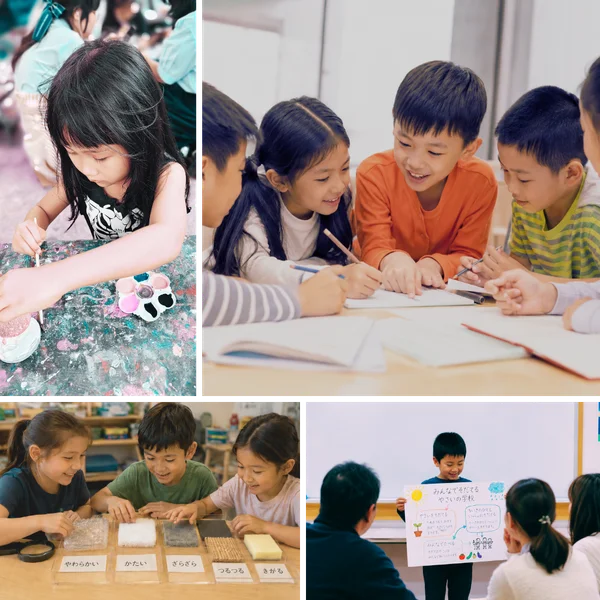
Progress is not measured only by how many words a child can recall on a test. We create more situations where they want to explain an idea, ask a question, solve a problem, or improve something — and help their Japanese grow to meet those needs.
Early Japanese can begin with naming, choosing, noticing, and reacting to what is happening in front of them.
Projects naturally create reasons to request materials, make choices, ask how, and respond to others.
As Japanese grows, children can move from a preference to a fuller explanation of what they want to do.
Children begin to give reasons, respond to someone else's idea, disagree, agree, and build on what another person said.
The long-term goal is Japanese that children can use not only to answer an exercise, but to think through an idea, work with someone, and create something that matters to them.

Conducting research in learning sciences, educational technology, language, and writing at the University of Toronto OISE (PhD Candidate). Designing the Nihongo Lab curriculum while directly mentoring children. We focus not just on memorizing words, but on how children ask questions, explore real materials, interact with peers, and express their own ideas in Japanese.
We ask open questions like "What did you notice?" or "How would you say that in Japanese?" to encourage children to explore, try new expressions, and build confidence.
Children can join whether Japanese is completely new or they understand it at home but rarely speak it. Everyone can work on the same project while receiving different language support.
We don't assume anyone at home can preview lessons or help with Japanese homework. Family communication can be in English.
Children can begin without knowing hiragana. From the first session they meet the language inside the activity.
Children with and without Japanese-speaking families join the same activities. Only the support changes.
If an idea arrives in English, children are always given choice to express in English or challenge themselves in Japanese, depending on their comfort levels. We never shut down the wish to say something.
Choose from 2 learning options tailored to your child's goals and curiosity.
The first 90-minute trial session is completely free.
Our standard course where children collaborate on hands-on projects and develop natural Japanese communication skills through making and dialogue.
In addition to group projects, mentors provide close individualized support for each child's own personal projects and creations.
The first class (90 minutes) is free to attend.
Children who can express themselves freely in Japanese can step right into Think Lab to continue their learning with more advanced Japanese and thinking skills.
No Japanese required to start. Try a class designed for children to find joy in using Japanese.